
Klinkers
DESIGN SIMONA SBORDONE
.avif)
The story
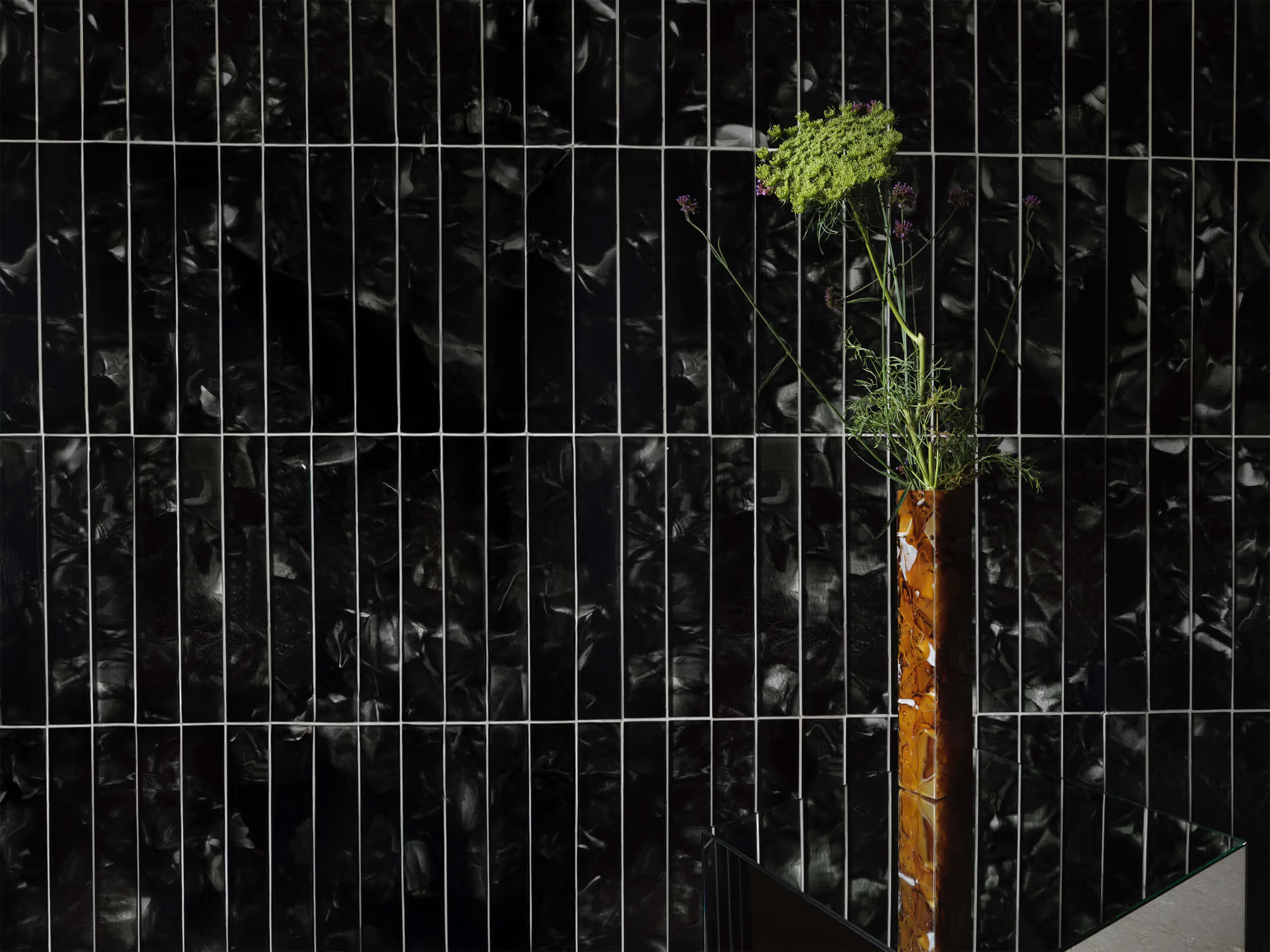
Working with a simple yet striking linear form, Simona Sbordone has designed original cladding tiles called klinkers, a name she chose for several reasons:
"The name 'klinker' has historical roots because it carries a charm and sophistication that were popular in the design and architecture of the 1960s. In the context of contemporary design, this material represents a perfect synthesis of elegance and durability. Klinker tiles gained fame through their use in various architectural projects, particularly in Milan. Their application became a symbolic element of the broader movement in postwar Italian design, which was characterized by a unique fusion of functionality and beauty.
The emphasis on materials and forms during this period helped define the style of those years, an era that sought to balance modernity with tradition."



simona sbordone
ART DIRECTOR BROKISGLASS
Born in Naples, Simona Sbordone currently lives and works in Milan. Throughout her remarkable international career, she has collaborated with some of the most prestigious Italian design brands, building a global network of clients. Her expertise spans a wide range of fields, including interior design, scenography, decorative arts, and industrial design.
In addition to her creative projects, she has also worked as an editor for leading Italian design magazines.

Materials and colours
Klinkers are subtly textured rectangular tiles with polished edges. A white diffusion coating is applied to the back to prevent transparency.
The material used for klinkers can be either BROKISGLASS or massif. In both cases, the tiles are made from material discarded during the manufacture of lighting glass: shards in the case of BROKISGLASS, and solidified remnants of molten glass in the case of massif.
Klinkers are available in three colour variants: BROKISGLASS klinkers come in Triplex Opal and Smoke Grey, while massif-based klinkers are produced in Light Pink Massif.


TECHNICAL INFORMATION
Nominal dimensions
KLINKERS are supplied as individual pieces in the dimensions specified in the pictogram. These represent the initial dimensions, which may be affected by the final manufacturing process/polishing. Therefore, a possible deviation from the dimensions indicated in the pictogram of ±0.5–1.00 mm per axis should be taken into account. Non-standard dimensions are available as a CUSTOM REQUEST.
Thickness
The final thickness is approximately 9.5–10 mm. However, due to the manufacturing process, an occasional deviation of up to 0.5 mm may occur.
Weight
The average weight of a single piece is approximately 560 g.
Colours
The currently available colours are: Triplex Opal BROKISGLASS (white), Smoke Grey BROKISGLASS, and Light Pink Massif.
Texture
The colour varies slightly with each piece and depends on numerous factors, such as the fraction of glass shards used, their orientation, distribution, etc. This is a unique material, and every tile is original. During the manufacturing process, the tiles are rotated to achieve an uneven surface.
Surface finish
KLINKERS are manufactured with a gloss finish for easy maintenance/washability.
Edge finish
The side surfaces/edges of KLINKERS are finished with polishing. The fine polishing of the edges results in a slight rounding of the edge along with a polished finish on the side of the tile. As a result, the surface is not matte but glossy, just like the visible surface of KLINKERS.
Back finish
The reverse side of the segments is coated with a white safety layer, ensuring that the underlying surface (adhesive) remains invisible.
Materiál
Upcycled glass from primary production of high-quality glass in Czechia with a tradition dating to 1809. No added ingredients. 100% safe, recyclable.
Other properties
Minimal absorptivity
High resistance to water and aggressive chemicals
Easy maintenance
High resistance to wear
High resistance to odour absorption
Unmistakeable colouration and texture
100% safe and environmentally friendly
Waste from the segments is fully recycled by the manufacturer
Applications
A wide range of uses. Consideration must be given to the unique properties of the mosaics. In addition to traditional applications, the mosaics can be glued on glass or used in backlighting installations, for instance, which are currently in development.
Recommended materials
Doporučená spára
For segment spacing, the final decision is up to the customer; however, considering the application of grout, a minimum 2 mm gap is recommended.
Recommended base coat
Recommended underlayment base coat prior to gluing mosaics, e.g. Ceresit CT175
Recommended adhesive
Cementitious adhesive Mapei Adesilex P9 C2TE is specially formuated for gluing glass mosaics with no vertical slip and extended open time. Suitable for interior and exterior applications.
Recommended grout
A two-component acid-resistant epoxy compound from the manufacturer Mapei, labeled Kerapoxy, is available in 26 colours and can also be used as an adhesive. The recommended shade in accordance with the offered color variants is 133 – SAND.
Defects
Bubbles in the glass
During the manufacturing process, air bubbles may appear in the glass. This is not a defect or a sign of reduced quality and therefore may not be the subject of a warranty claim. We never ship any product that does not meet our strict quality control standards. Such anomalies are unique trademarks of handmade glass, and the presence of up to 3 air bubbles 1.5–2 mm in size per segment with sealed surface is not grounds for a warranty claim.
Drobné pigmentové skvrny
Though rare, small pigment spots (< 1 mm) may occasionally occur. Pigment spots are the result of minerals that are not visible at the time of manufacture but become visible during the process. Pigment spots occur more often in the Triplex Opal (white) glass. Our quality control standards do not permit pigment spots in more than 5% of the surface area. Such anomalies are unique trademarks of handmade glass.
Hairline cracks in the surface of the glass
When they appear at joints between individual fragments, they are not grounds for a warranty claim. Such cracks are superficial only and do not extend into the material, thus they have no effect on the declared properties of the material.
Visible waterjet entry point
The waterjet entry point takes the form of a subtle notch. This is entirely normal. The technology provides no way to prevent this during manufacture; however, the irregularity is minimized in subsequent operations.
.jpg)